Lindoga ist ein grossartiger Service
Sagt Lingoda. Und was Lingoda sagt ist immer richtig. Weitere Diskussion zwecklos. Kennst du Lingoda noch nicht? Dann probier es doch gleich mal aus mit deiner ersten Email an Support@
Remote IP address 88.99.219.174
Initiator
Script nrWrapper at login:26:1631
Remote IP address
23.62.165.92
Initiator wave.outbrain.com/mtWavesBundler/handler/003b3e65fd102a7aa5edc320b869538d60
Script nrWrapper at login:26:16312
Script cdn.elev.io/sdk/main/v4/1698038053545/elevio-main.js
nrWrapper at login:26:16312
polyfill.io/v3/polyfill.min.js?flags=gated&features=Promise.prototype.finally%2Ces2015%2Ces2016%2Ces2017%2Ces5%2Ces6%2Ces7%2Cfetch%2CObject.fromEntries%2CIntersectionObserver%2CIntersectionObserverEntry%2CResizeObserver%2CIntl.~locale.en&version=3.101.0
parser
href="//fonts.googleapis.com/css?family=Open+Sans:300italic,400italic,700italic,400,300,600,700"/>
/*
* Braze Web SDK v3.2.0
* (c) Braze, Inc. 2021 - http://braze.com
* License available at https://github.com/Appboy/appboy-web-sdk/blob/master/LICENSE
* Compiled on 2021-02-25
(()=>{var t={39971:(t,e)=>{var n,r,o;!function(i){if("undefined"!=typeof window){var c,s=0,u=!1,a=!1,f=7,l="[iFrameSizer]",p=l.length,d=null,h=window.requestAnimationFrame,v=Object.freeze({max:1,scroll:1,bodyScroll:1,documentElementScroll:1}),g=
https://apps.rokt.com/wsdk/controller/index.7a80977aff050a6a0b30.js
(()=>{"use strict";const e=()=>{},t=(t=e,s=e,i=e)=>"function"!=typeof t?t:{next:t,error:s,complete:i};class s{constructor(){this._subscribers=[]}add(e){this._subscribers.push(e)}unsubscribe()
dx.mountain.com/spx?dxver=4.0.0&shaid=32435&tdr=&plh=https%3A%2F%2Fteacher.lingoda.com%2Fteacher%2Flogin&cb=17620512715043924term=value
https://teacher.lingoda.com/build/teacher/943.763e4975.js
(self.webpackChunklingoda=self.wbpackChunklingoda||[]).push([[943],{3123:function(n,e,t){"use strict";var o;t(9306);(o="undefined"!=typeof window?window:
var OneTrustStub=function(t){"use strict";var a,o,p=new function(){this.optanonCookieName="OptanonConsent",this.optanonHtmlGroupData=[],this.optanonHostData=[],this.genVendorsData=[],this.vendorsServiceData=
(self.webpackChunklingoda=self.webpackChunklingoda||[]).push([[359],{9003:function(b,M,z){"use strict";var p=z(9957),O=z.n(p),A=z(3957),o=z.n(A),c=z(5553),n=z.n(c),q=z(2374),e=z.n(q),W=z(5606),a=z.n(W),f=z(9217),t=z.n(f),d=z(166),r=
(()=>{"use strict";var e={865:(e,t)=>{var n,r;t.__esModule=!0,t.LOG_TYPES=t.CONTENT_TYPE=t.Zone=t.GDPR_PURPOSE_CONSENTS=t.HAS_CONSENT_EVENT=t.VERSION=void
https://connect.facebook.net/signals/config/820209728092685?v=2.9.138&r=stable&domain=teacher.lingoda.com
-----BEGIN CERTIFICATE-----
MIIDQTCCAimgAwIBAgITBmyfz5m/jAo54vB4ikPmljZbyjANBgkqhkiG9w0BAQsF
ADA5MQswCQYDVQQGEwJVUzEPMA0GA1UEChMGQW1hem9uMRkwFwYDVQQDExBBbWF6
b24gUm9vdCBDQSAxMB4XDTE1MDUyNjAwMDAwMFoXDTM4MDExNzAwMDAwMFowOTEL
/**
 * FingerprintJS v3.3.2 - Copyright (c) FingerprintJS, Inc, 2021 (https://fingerprintjs.com)
 * Licensed under the MIT (http://www.opensource.org/licenses/mit-license.php) license.
 *
 * This software contains code from open-source projects:
 * MurmurHash3 by Karan Lyons (https://github.com/karanlyons/murmurHash3.js)
/*! For license information please see modules.f8398e1fcf749800c3fc.js.LICENSE.txt */
!function(){var e={4788:function(e,t,n){"use strict";n.d(t,{s:function(){return r}});const
/*! For license information please see nr-spa-1.249.0.min.js.LICENSE.txt */
"use strict";(self["webpackChunk:NRBA-1.249.0.PROD"]=self["webpackChunk:NRBA-1.249.0.PROD"]||[]).push([[111],{9139:(e,t,i)=>{let s;i.d(t,{m:()=>r});const n=new Promise((e=>
T_COMPLETED:"PLACEMENT_COMPLETED",PLACEMENT_INTERACTIVE:"PLACEMENT_INTERACTIVE",PLACEMENT_READY:"PLACEMENT_READY",PLACEMENT_RESIZE:"PLACEMENT_RESIZE",PLACEMENT_FAILURE:"PLACEMENT_FAILURE",UPDATE_CART_ITEM_
* Copyright (c) 2017-present, Facebook, Inc. All rights reserved.
* You are hereby granted a non-exclusive, worldwide, royalty-free license to use,
https://www.googletagmanager.com/gtm.js?id=GTM-5ZZ4
// Copyright 2012 Google Inc. All rights reserved.

 (function(w,g){w[g]=w[g]||{};
/**
 * onetrust-banner-sdk
 * v202307.1.0
 * by OneTrust LLC
 * Copyright 2023
 */
!function(){"use strict";var A=function(e,t){return(A=Object.setPrototypeOf||({__proto__:
Accept:"application/json"}:{Accept:"application/json","mbsy-universal-id":window.mbsy?window.mbsy.uid:null,"mbsy-universal-location":window.location.protocol+"//"+window.location.hostname};var
!function(){"use strict";var A=function(e,t){return(A=Object.setPrototypeOf||({__proto__:[]}instanceof Array?function(e,t){e.__proto__=t}:function(e,t){for(var o in t)Object.prototype.hasOwnProperty.call(t,o)&&(e[o]=t[o])}))(e,t)};function I(e,t){if("function"!=typeof
window.__mbsyData=[{"url":"https://api.blue.getambassador.com/universal/integration_points/26852/","id":26852,"company_user_uid":25892,"default_language_uid":
Eine "schlechte Internetverbindung" ist ohne Zweifel die meisthoerte Antwort bei Anfragen an den Support nachdem mal wieder eine Klasse ausgefallen ist, weil man den Lehrer nicht hoeren und oder nicht sehen konnte. Der Support kann auch genau sehen, dass das Problem auf meiner Seite (als Lehrer) lag. Jegliches Argumentieren zwecklos, man bekommt bestenfalls die Empfehlung Zoom zu aktualisieren und den Rechner neu zu starten. Aber ist Zoom wirklich so empfindlich, dass selbst Schwankungen in der Bandbreite sofort einen Totalausfall der geplanten Klasse mit sich bringt? Die Systemanforderungen fuer Zoom sind nicht sehr hoch und jeder Standard PC oder Laptop erfuellt diese im Jahr 2023 problemlos. Das technische Setup bei Lingoda ist simple: Amazon Webservices, Load balancer und eine HTML Website zum buchen und verwalten der Klassen. Kurz vor Beginn des Unterrrichts wird der Klasse eine Zoom Session zugewiesen.
Also machen wir den Test: Computer aus der Steinzeit - Windows 7, 2GB RAM, Zoom Anwendung und die Bandbreite auf 5MB gedrosselt. Das sollte einige Probleme mit sich bringen. Tut es aber nicht wie ihr im Video selbst seht. Ich habe auch dem Support von Lingoda das Video per Email gesendet. Was denkt ihr was die Reaktion von Lingoda war?
Lingoda ist eine der besten Online-Sprachschulen. Wir wurden 2013 in Berlin, Deutschland, gegründet
Cryptocurrency mining is a process of using specialized software to solve complex mathematical problems in order to validate transactions on a cryptocurrency network and create new units of the currency. However, it can be resource-intensive, so some malware actors have turned to malware to covertly install cryptocurrency mining software on the computers of victims in a bid to generate profits. This type of malware is often referred to as “cryptojacking” malware. Cryptojacking is growing in popularity and recent reports suggest that there has been a sharp increase in crypto-miner variants in Q3 2022, with a growth of over 230% compared to the same period in 2021. Furthermore, the research claims that the first quarter of 2022 saw the biggest number of users afflicted by fraudulent mining software, with over 500,000 individuals affected.
Cryptocurrency mining is the process of using specialized software to solve complex mathematical problems to validate transactions on a cryptocurrency network and create new units of the currency. It can be a resource-intensive process that requires significant computing power. As a result, some malware actors have turned to malware to covertly install cryptocurrency mining software on the computers of victims in a bid to generate profits.
This type of malware is often referred to as “cryptojacking” malware. Since it is resource-intensive malware actors have been also targeting organizational cloud resources for coin-mining purposes. A recent incident as reported by Stephan Berger on his official Twitter handle was where a Threat Actor (TA) compromised an Azure Global Admin Account, which they used to spawn up over 200 (Virtual Machines) VMs to mine cryptos with it. Due to a lack of detection capabilities, it was only noticed due to extreme Azure costs.
Prominently growing over time, with more than 500,000 individuals affected only in 2022 according to Kaspersky reports.
Uses the processing power of the victim’s computer illicitly to mine cryptocurrency, allowing cybercriminals to remain hidden for months.
Become a profitable criminal activity, with an estimated income that reaches up to $40,500 (2 BTC) per month.
In constant evolution, resulting in a higher difficulty to detect and a single/host-based method might not work for each case.
Typically discovered by monitoring excessive CPU or memory consumption on endpoint devices, but this becomes more difficult in cloud infrastructures

sagt ein altes Sprichtwort aber bei Lingoda war das genau das Gegenteil. Bewerben kann man sich immer und ein einfacher Upload des Lebenslaufes genuegt.
Aus welchem Grund koennte Lingoda ein Interesse daran haben falsche Informationen zu verbreiten? Oder welche Informationen will man geheim halten?
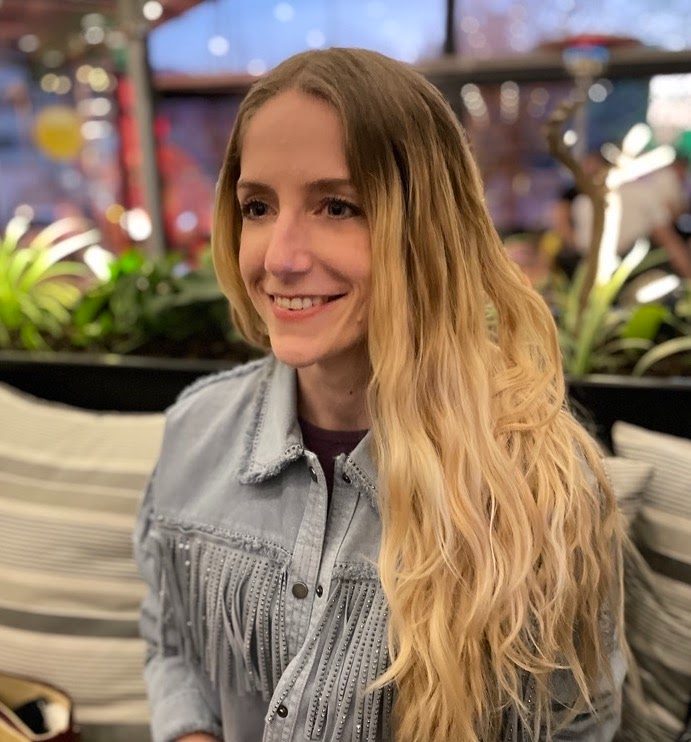
Bonjour! My name is Marine and I am French. I’ve lived in many different countries (Lithuania, Bosnia and Herzegovina, France, Belgium) and I am currently based in Tirana, Albania. I speak French, English, Bosnian, a little bit of Spanish and I am currently working on learning German. I studied languages, political science and international relations. In my free time, I love hiking, travelling and eating (what? It’s not a hobby?). I am really happy to be part of your Teacher team at Lingoda and look forward to exchanging more with you all!
She lives in Albania but works for Lingoda Berlin She does not speak Albanian, why Albania? Working on learning German? Try Lingoda? Nobody says like eating. Foodie, Passionate about Food, International Cuisine, ...
Hi, everyone! My name is Nemanja and I come from Serbia. I've studied English and Spanish at University of Belgrade and apart from those two languages I also speak Serbian and I'm currently learning Korean and German. I love getting to know more about different cultures and visiting as many new countries as I can - especially if there's some spicy food involved! I'm very excited to be able to talk with you more on a day-to-day basis here at Lingoda!
-wNg.jpg)
Hello everyone! My name is Shanti and I come from Germany. Languages, traveling, and experiencing new cultures were always my passion, so I studied Tourism and Spanish in the UK. After finishing the last year of my degree in the Canary Islands, I stayed there for seven years. I speak German, English, and Spanish and, as I recently moved to Catalunya, I'm now learning Catalan. I used to teach German as a second language, both online and offline. In my free time, I enjoy following research in the field of language teaching, and I also love climbing, hiking, and skiing. I'm happy to be here and glad to work with you, dear Lingoda teachers!
Shanti again in outdoor clothing, another Stockimage. No idea why she moved to Spain working for a German company. All these profiles just another Lingoda created illiusion. The multi national teacher team.
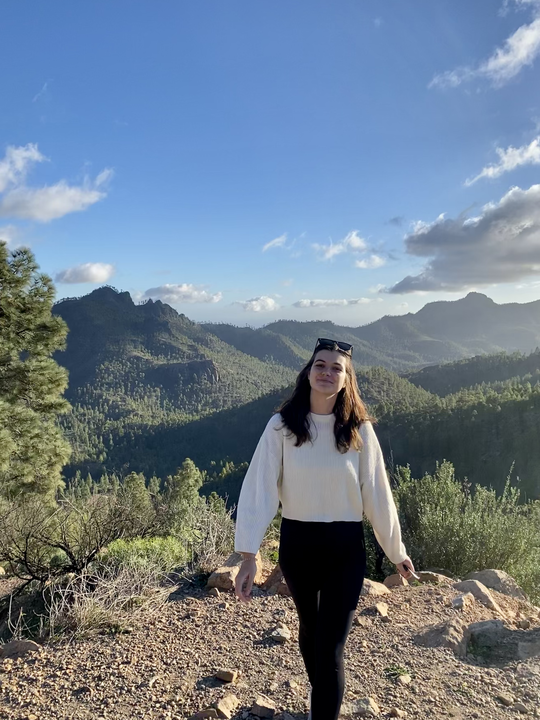
My name is Melina and I’m from Spain, but I’m half-German on my mother’s side. I studied Modern Languages in Gran Canaria, which is where I’m from and currently live, and did a master’s in Cultural Management in Edinburgh. I speak Spanish, German, English and a bit of French (currently brushing up on that one) and am learning Italian. A little more about me, I love baking and have conquered sourdough bread, I’m an avid traveler and I love education, having been teaching languages on the side for the past 6 years, which is why I’m excited to be a part of the Teacher Team at Lingoda!
-R2I.png)
Hi, my name is Daria, I come from Moscow, Russia, and I've been living in Berlin since 2017. I am really passionate about languages! I studied in different countries (Russia, Spain, Germany and Hungary), finished my MA in Linguistics in Berlin, and I also used to teach Russian as a foreign language and German. I speak Russian, English, German, Spanish and I’m currently learning French. In my free time, I love knitting & crocheting. I'm glad to work with you, dear Lingoda teachers!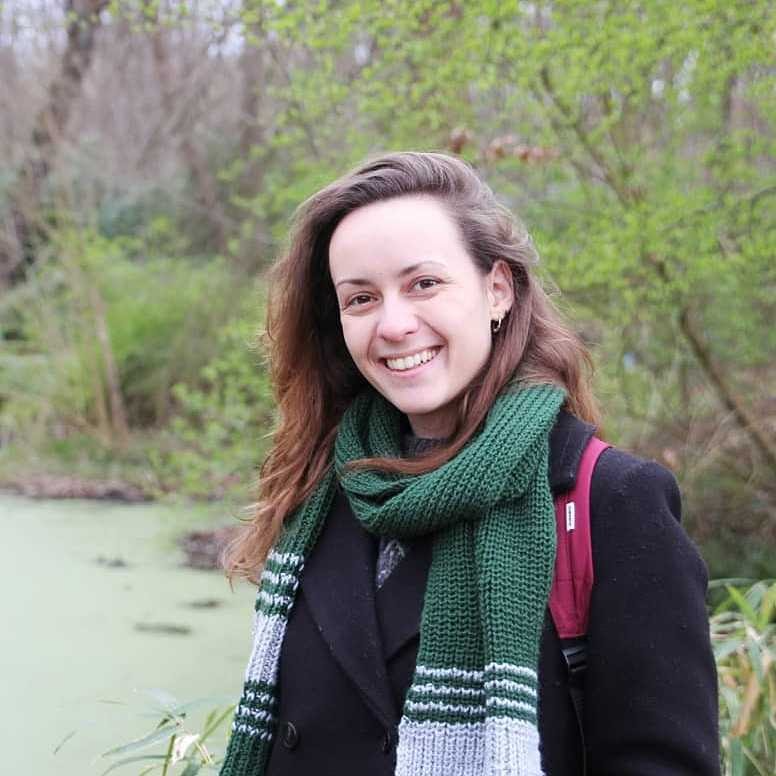

Author: LesleyHaw7
Cyberian Mine — (their version of my version :)
https://cyberianmine.de/blog/last-mine-standing-menu/
The Last Mine Standing Menu: Warm Beer, Cold Women and Fast Food Served Slow
One of the notable headlines last week was that cryptocurrency platform Bakkt is releasing an app for consumers to use at Starbucks and other places to seamlessly spend bitcoin. Soon, you’ll inevitably be able to eat and drink your way through most of the world’s major cities with crypto. But as recently as three years ago, things were a little different. You had to head to a place called Room 77 in Kreuzberg, Berlin, to spend your bitcoin.

The Cyberian Mine team feels at home at Room 77
The “restaurant at the end of capitalism” prides itself on “warm beer, cold women and fast food made slow” and has been accepting bitcoin as payment for beer and burgers since 2011. On receiving his first customer payment in bitcoin, Room 77’s owner, Joerg Platzer, said, “I felt 20 years younger. This was the sort of money I read about when I was young.” Room 77 has an understated but unmistakably cyberpunk vibe. In 2018, when Cyberian Mine closed its angel investment round, the team chose Room 77 as the place to celebrate. And it’s also where we met Lesley Haw.
Lesley isn’t one of the “cold women” Room 77 advertises. She’s a Berlin-based writer and former journalist and radio producer for BBC Scotland. She specializes in startup, tech and cultural features and has written for Metro AG, Techstars, Silicon Allee, Zalando and GetYourGuide. Lesley interviewed our management team and wrote this Medium article based on her impressions of the company. Here are some highlights:

Bitcoin on the window, on the chat and to pay for the beers
On establishing Cyberian Mine as a German GmbH
“We thought if we could handle the German bureaucracy, we could do anything, and when people see this they know we are serious. It took us more than a month to open a bank account because no one wanted us. Fourteen banks rejected us when we applied to open a new account.”
On the purpose of Bitcoin
“The point of Bitcoin is not to make us rich, not to make our customers rich, but to have a new financial system based on decentralised technology and not gatekeepers like Deutsche Bank or Bank of England.”
On using green hydro-electricity to mine bitcoins:
“Not only are we using renewable energy — we‘re doing it completely transparently. We don‘t hide any of our margins, and we help people actually make money in mining, rather than some of the previous competitors who just rip people off, especially in the cloud mining sector.”
To read the full article, pop on over to Medium.

No matter where the conference is, our work in Siberia continues strong
The time is now…
If you’re ready to begin your mining adventure with Cyberian Mine but won’t be at GVS, the first port of call is our free Telegram group, where we share all the latest details about our mining machines and hosting opportunities before anywhere else.
Follow the link below to join.
Verdienter Ruhestand sagen die einen - Mord sagen die anderen.
Was wirklich passiert ist mit dem ex BKA Chef Goetz Knobloch bleibt unklar.
BlackOrchid Blume des Jahres 2023 ernannt in Erinnerung an Goetz Knobloch.
